
The curry isn’t the only part of the meal to plan. For a chicken curry, a useful starting point for how much curry to order per person is about 125g of chicken, based on an easy recipe that uses approximately 500g of chicken breast for 4 servings. Treat that as a guide to the main ingredient, then adjust for the other dishes on the table.
It’s easy to order too much when rice, naan and chutney are part of the spread, or too little when curry is the main event. This guide explains how to estimate curry portions for a group and adjust for the sides. Use it as a practical starting point, while allowing for your guests’ appetites and the menu.
Key Takeaways
- Scale chicken curry around the number of guests, then allow for appetites and the rest of the menu.
- Use the ingredients in a large vegetarian curry recipe to guide your group quantities.
- Decide whether curry is the main event or one of several dishes before planning rice, naan and chutney.
- For a ready-made curry option, explore Phulkari Indian Balgowlah’s Goan Fish Curry alongside the other dishes on offer.
Chicken curry quantities for a group
Start with the curry, then adjust for the sides and your guests’ appetites. Use the restaurant’s serving information as your baseline when it’s available.
- Calculate the chicken. An easy chicken curry recipe uses approximately 500g of chicken breast for 4 servings. That works out to about 125g per person. For a group, multiply the guest count by that amount, then consider whether curry is the main dish or one of several.
- Scale the ingredients together. The same recipe includes 240ml chicken stock, 400ml full-fat coconut milk, 60g baby spinach and 2 tablespoons of mild curry powder. These ingredients create the sauce and flavour around the chicken. If you increase the chicken, scale the other ingredients too, while adjusting liquid to suit the consistency.
Account for side dishes and serving sizes
Before estimating portions, decide whether curry is the main dish or one part of a shared meal. Rice, naan and chutney make a fuller spread, so guests may serve themselves less curry than they would if it were the only main. Restaurant portions vary by dish and serving format, so don’t assume dine-in and takeaway servings are identical. There’s no standard serving count for a takeaway container across Australian restaurants; use the menu’s serving information where available. Prices also vary by venue, dish and accompaniments, so there’s no single useful per-person price.
Adjust portions for different appetites
Allow less curry for children than for adults, and plan more for guests with larger appetites. The 500g chicken example is a starting point for 4 servings, not a fixed rule for every group. If you want leftovers, add an extra serving to your total rather than increasing every ingredient by guesswork. For a mixed group, estimate adult portions first, then adjust for children and hearty eaters. Keep the sauce and chicken in balance as you scale.
Vegetarian curry quantities for a group
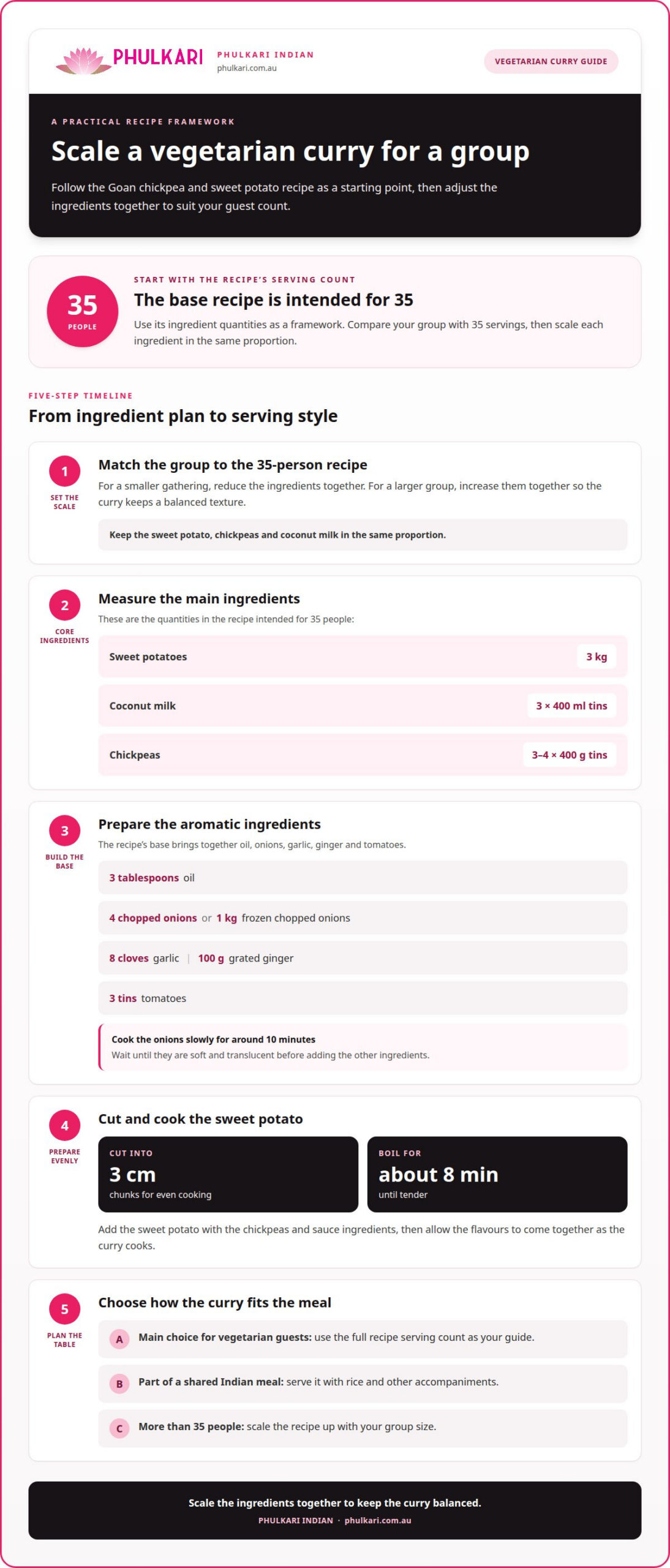
- Use a group recipe as your starting point. A Goan chickpea and sweet potato curry recipe is intended for 35 people. It uses 3kg of sweet potatoes, 3 tins of coconut milk at 400ml each, and 3-4 tins of chickpeas at 400g each. This gives you a practical ingredient framework for a large vegetarian meal.
- Scale ingredients to match your guest count. Compare your group with the recipe’s 35 servings, then scale each ingredient in the same proportion. For a smaller gathering, reduce the sweet potato, chickpeas and coconut milk together. For a larger one, increase them together so the curry keeps a balanced texture.
- Build the aromatic base before adding vegetables. The recipe uses 3 tablespoons of oil, 4 chopped onions or 1kg of frozen chopped onions, 8 garlic cloves and 100g of grated ginger. It also calls for 3 tins of tomatoes. Cook the onions slowly for around 10 minutes, until soft and translucent, before adding the other ingredients.
- Keep the sweet potato pieces consistent. Cut them into 3cm chunks so they cook evenly, then boil them for about 8 minutes, until tender. Add them with the chickpeas and sauce ingredients, and allow the flavours to come together as the curry cooks.
- Plan the serving style. For an Indian meal with several dishes, vegetarian curry can share the table with rice and other accompaniments. If it’s the main choice for vegetarian guests, use the full recipe serving count as your guide and scale up when your group exceeds 35 people.
How much curry should you order per person for a side dish?
For a shared meal, plan curry as one part of the spread rather than the only main. Count the other substantial dishes first, then decide how much curry to order for the table.
- List the dishes that will share the meal. Note whether rice, naan, vegetables or another main will also be served. A table with several substantial dishes needs less curry than a meal built around one curry and rice.
- Decide how guests will serve themselves. If everyone shares dishes, estimate the curry as a contribution to the whole spread. If each guest receives a plated meal, allow a fuller curry portion beside the rice or naan. Avoid ordering a main-sized amount automatically when several mains are already planned.
- Match the curry quantity to its role. For a side, think in tasting portions rather than full bowls. A mild curry alongside a richer dish may be sampled differently from the main flavour guests return to. Consider the menu’s balance and whether guests can choose between meat and vegetarian dishes.
- Plan accompaniments separately. Rice and naan help make a shared spread satisfying, while chutney adds a small, flavourful accent. Don’t count chutney as a substitute for curry. Keep serving spoons with shared dishes, so guests can take a little of each without crowding one dish.
- Allow for the way the group eats. A long meal with several courses may call for less curry at the start than a casual gathering where dishes remain on the table. For takeaway, divide the order according to the planned meal, rather than assuming each container equals one person’s serving.
Phulkari Indian Balgowlah: Goan Fish Curry
Phulkari Indian Balgowlah gives you a ready-made curry choice when you’d rather plan the gathering than cook. Goan Fish Curry can bring a distinctive flavour to a shared spread, while Butter Chicken and Lamb Rogan Josh offer other curry options. Add Garlic Naan when you’re planning bread alongside the meal.
Use the guidance above to decide how curry fits with rice, naan and other dishes. If your group has varied tastes, choose different curries so guests have options. Build the spread around your guests’ appetites and the role each dish will play.
Contact Phulkari Indian Balgowlah to discuss your curry choices.
Make your next curry gathering easy to plan
You can now plan the meal around your guests, whether curry is the centrepiece or one part of a shared spread. Estimating how much curry to order per person is a useful starting point; tailor the final mix to your guests’ tastes and how you plan to serve dinner.
For a ready-made meal, Phulkari Indian Balgowlah offers Butter Chicken and Lamb Rogan Josh, with Garlic Naan to accompany the curries. Choose the combination that suits your table, then enjoy the pleasure of gathering everyone around fragrant, generous dishes.
With a little planning, you’re ready to bring good food and good company together.
Frequently Asked Questions
What’s a suitable curry portion for a main meal?
Plan one substantial curry portion per diner, then add rice or naan to round out the meal. How much curry to order per person also depends on whether guests can choose from several curries. Divide the group’s appetite across those options instead of ordering a full portion of every dish for everyone. For example, serve chicken and vegetarian curries with rice.
How much curry should you order per person for a buffet or shared meal?
For a buffet, plan curry as part of the whole spread, not as each guest’s only dish. To estimate how much curry to order per person, consider the other substantial options and whether you’ll serve rice or bread. If guests can choose freely, offer a mix of curries and place a serving utensil with each dish.
How much curry does an Indian restaurant serve per person in Australia?
Indian restaurants in Australia don’t all use the same serving size. Portions vary by dish, serving format and accompaniments. A dine-in meal served with rice, for example, may feel different from a takeaway curry ordered separately. Use the menu’s serving description when available and plan around the full meal.
How much curry should you order per person when ordering multiple dishes to share?
Order less of each curry when your group will share several substantial dishes. Decide how many curries and other mains to serve, then divide the group’s appetite among them. A mix of chicken, lamb and vegetarian curry gives guests variety without treating every dish as a separate full meal.


